Ilan Averbuch
After the Fire
November 5 - December 24, 2026
After the Fire is a new body of sculpture and works on paper by Ilan Averbuch, his first exhibition at Nancy Hoffman Gallery since 2017. The exhibition continues a defining thread in Averbuch’s practice: the transformation of materials recovered from built environments – stone pulled from old bridges, curbstone salvaged from city streets, steel drawn from industrial sites – into vessels for memory, history, and interpretation.
The exhibition brings together sculptures in granite and steel with an extensive body of drawings, including large-format works on paper and smaller drawings framed and installed together in a single, mosaic-like composition. The accumulation of drawings creates a field of shifting scale, gesture, and mark-making, placing the intimacy of the drawn line in dialogue with the physical weight and monumentality of Averbuch’s sculpture.
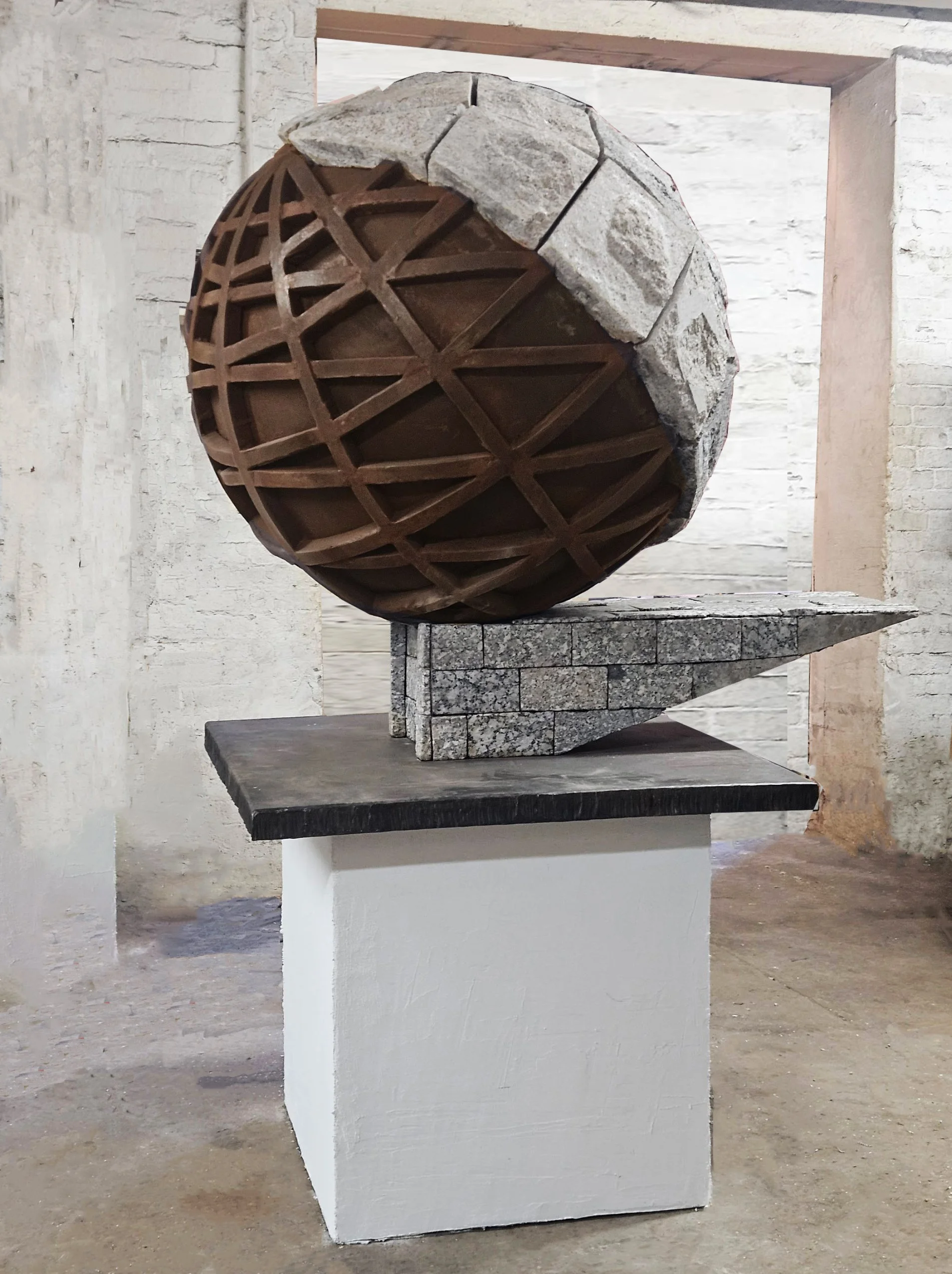
Central to Averbuch’s practice is what he calls a “rupture of balance.” Providing recycled materials with a new purpose, he resists the notion that a structure’s first function determines its final meaning. The resulting works transform the heavy and literal objects into something more elusive, imbuing them with a sense of memory, movement, and suspension. In Red Moon, stone and steel form an eclipse that shifts and dissolves as the viewer moves around it. Nearby, Even Walls Can Move transforms brick and bent steel on an intimate scale, enlivening the brick wall in a boat form, providing it with a sense of animacy and motion. On a larger scale Bearers of Memory extends this inquiry into human ingenuity and the long history of migration.
“My work is a search for the meeting point between the earth and the human mind,” Averbuch reflects. “I am interested in how a massive stone can suggest a state of flight, or how a rigid steel wall can appear to bend under the weight of history.”
The exhibition also finds Averbuch confronting questions of heritage and identity. It Is Not is a large, low-to-the-ground steel sculpture in the form of a seven-pointed star. Carved granite heads lie beneath its weight while simultaneously serving as the supports that hold the structure upright, bearing the star’s full mass as they remain pinned beneath it. The work grapples directly with the artist’s identity in the shadow of the war in Gaza, refusing an easy or symmetrical resolution. Elsewhere, Greif (Masks) presents four carved stone visages, their eyes closed and expressions drawn downward in a shared, wordless sorrow, hovering between portrait and relic.
After the Fire gathers more than a decade of Averbuch’s sculpture and drawing practice in an exhibition concerned with the persistence of material – and with the ways memory, history, and inheritance remain embedded within it.
Based in Long Island City, New York, Averbuch has created sculptures and public installations in cities across the globe, from the Supreme Court in Jerusalem to the Governor Mario M. Cuomo Bridge in New York.
Averbuch was born in Tel Aviv, Israel. Averbuch’s work is held in numerous prestigious collections, including the Art Institute of Chicago, the Brooklyn Museum, and the Tel Aviv Museum of Art. This exhibition follows a series of major 2025-2026 public sculpture commissions, including his recent commission for Fire House 46 in Charlotte, North Carolina and the Bicentennial Park in Macon, Georgia.